
A Clarasight White Paper
How To Forecast Travel Spend Before Tickets Are Booked
Estimating trip costs to resolve uncertainty and manage spend
A Clarasight White Paper
Estimating trip costs to resolve uncertainty and manage spend
Introduction
Every travel and finance leader faces the same problem when a big meeting or an annual budget is on the table: you have to commit to a number long before anyone books a flight.
Live fares only exist about 11 months out, prices swing week to week, and the true cost isn't clear until every ticket is purchased. So you approve budgets on rough guesses, then spend the rest of the year explaining the variance when actuals come in higher.
Clarasight gives you a dependable number up front. Our model predicts airfares months ahead of booking, trained on a broad set of real market fares rather than any one company's history, so it can price a trip on day one and even handle routes it has never seen. That means you can set a meeting budget you'll actually hit, and compare options like “New York in August” against “Chicago in September” side by side before committing a dollar.
This paper explains how the model works, why airfare is so hard to predict, and how we built one accurate enough to plan a full year around.
Section 1
Clarasight enables companies to travel smarter and with greater efficiency.
To do this, our product has to internally answer a multitude of questions at any single point in time, including on occasion a simple-sounding question: what will it cost to fly some group of people to a particular city, on a particular date?
The answer depends on where every attendee starts, which routes they might fly, when they will book, and what cabin class they are entitled to. Each of those variables carries some amount of uncertainty, which can be massive when multiplied by the number of attendees. The true cost of the meeting will not be fully realized until every ticket and hotel has been booked.
And yet, Clarasight strives to provide some measure of assurance, even in the face of this uncertainty. Our platform provides directional guidance for planning a gathering, using a customer-agnostic approach that reflects the latest knowledge about airfares.
This paper covers the model behind that estimate: a machine learning model trained on market-wide fare data, with non-route-specific features allowing for broad generalizability. We'll cover why the problem is harder than it looks, how the model is built and trained, and why that approach is what makes rich what-if scenario planning possible.
Section 2
Our product is able to produce per-trip cost estimates for every attendee at a particular meeting or event, which are then aggregated up to a total meeting cost, before any flight has been searched or booked.
There are two broad classes of solutions that can be used to address this problem: surfacing live pricing and predicting airfares ourselves. Live pricing comes with several downsides that ultimately make it untenable for supporting the Clarasight product.
Live fares run out at the horizon. bookable airfares are typically only available up to about 11 months into the future, with potentially less variety on the far end of that timeline for particular routes. This inherently limits Clarasight's ability to be used for top-down planning decisions across an entire fiscal year.
Live fares are volatile. Because airfares can be volatile and meeting planning might take place many months before booking, using a live cost value will lead to unstable estimates that don't reflect the usual expected booking lead time.
An internal model sidesteps these problems. If we train the model on features that generalize to an arbitrary route booked at an arbitrary point in time, we can provide a stable estimate of cost for a booking at any point in the future.
Section 3
Airfares are influenced by a wide variety of factors: day of the week, lead time of booking, cabin class, length of the trip, trip type, carrier (or number of carriers that serve a route), time of day, oil prices (current and historical), holidays, hyperlocal event-driven forces (like conferences or sports games), and dynamic pricing.
There can also be niche influences, in which a one-way or open-jaw (multiple one-ways) trip is priced disproportionately high (or low) relative to a round trip, an effect that might play out differently by carrier and route.
As a function of all of these forces, airfares move day over day, and potentially even hour over hour. Accurate prediction is of great interest to price-sensitive consumers and businesses, and many companies and organizations have strived to provide accurate pricing models. Even so, this is an extremely difficult problem to solve consistently. There are companies in existence, like Hopper, whose multi-billion dollar valuations are driven primarily by their proprietary price prediction algorithms.
Acknowledging this technically complex landscape, our goal here cannot (and should not) be perfect accuracy. While we strive to produce an accurate model for lowest available fare, our bar is different: we need to build a model that is useful every day.
Lowest fare vs. booked fare. There is a real difference between predicting the lowest available fare for a route, a purely objective quantitative question, and predicting the fare a specific traveler will actually book, which depends on airline loyalty, layover tolerance, and timing preferences that vary person to person, plus fare-tier add-ons like seat selection and bags that push the realized cost above the lowest quoted fare.
A model trained on the lowest available fare will systematically underprice what a company actually pays. However, with appropriate permissions and under safe parameters, Clarasight can leverage a customer's own data to learn and apply corrections to account for behavioral differences.
Section 4
The basis of Clarasight's airfare estimates is a machine learning model trained entirely on publicly available Economy and Business airfares from 98 airports and roughly 1,800 airport pairs, not on any customer's own bookings. This means the same model can price any customer's trip on day one, with no history required.
The model is deliberately built on inputs a travel planner might already reason about, rather than opaque or engineered proxies:
That list is intentionally simple. Every input has an obvious real-world meaning, so we can sanity-check the model the same way we'd sanity-check a person's intuition: longer trips should cost more, Monday departures should price differently than Thursday ones, and so on. Simple, recognizable inputs also generalize better than route-specific features, which require much more data in the training corpus.
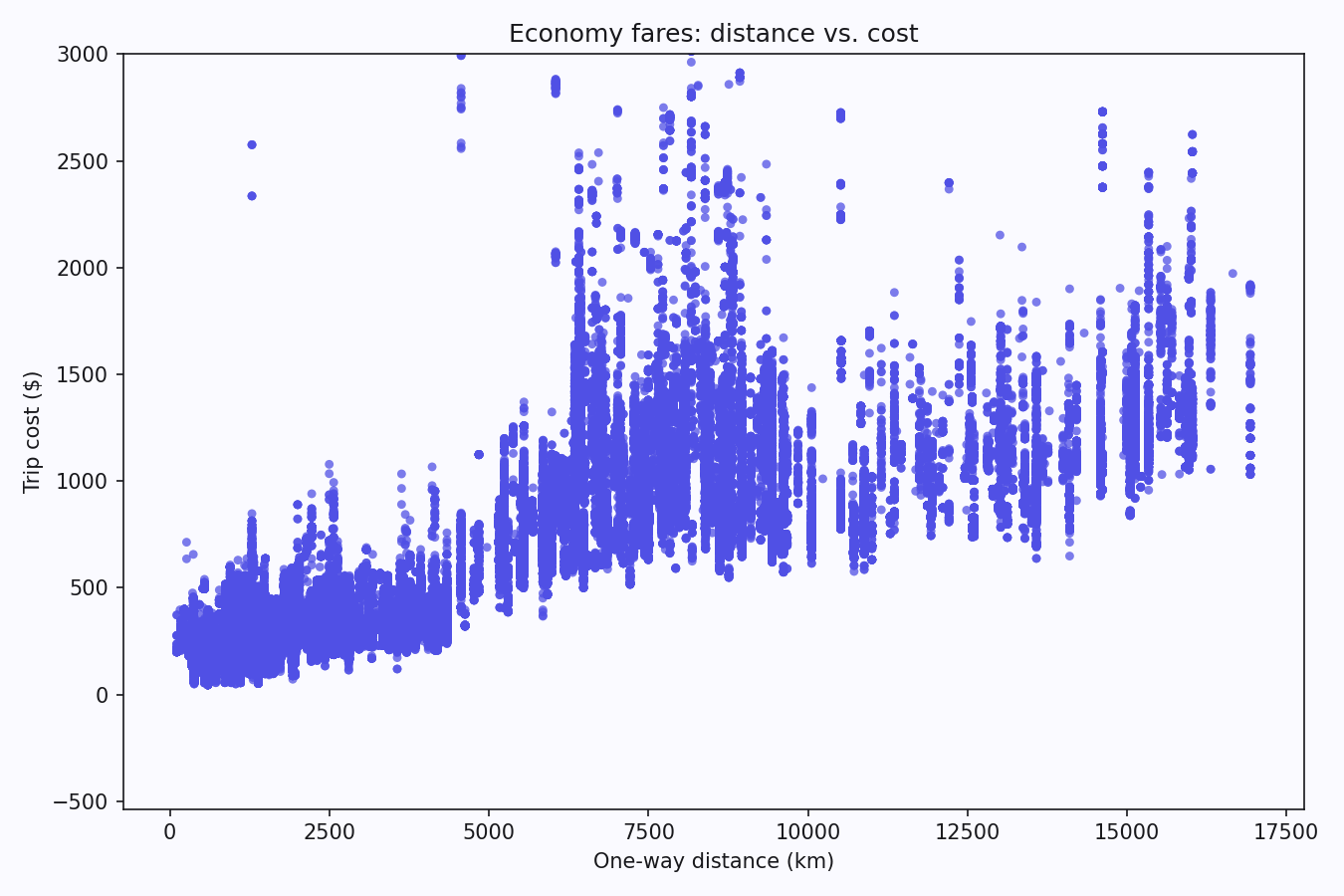
We can see the benefit of our approach in elements of Figure 1, below. This chart, which is a plot of total airfare vs one-way distance, shows two important features. The overarching positive trend between trip distance and airfare is obvious and intuitive, and on its own explains a fair amount of the relationship between the two. However, it’s clear that this is far from the only thing that determines the airfare. For a fixed distance, cost can vary significantly around the median value. By adding other explanatory variables that encode similar underlying relationships, we can further improve on this simple one in straightforward ways. In summary, distance is directionally predictive but far from the whole story.
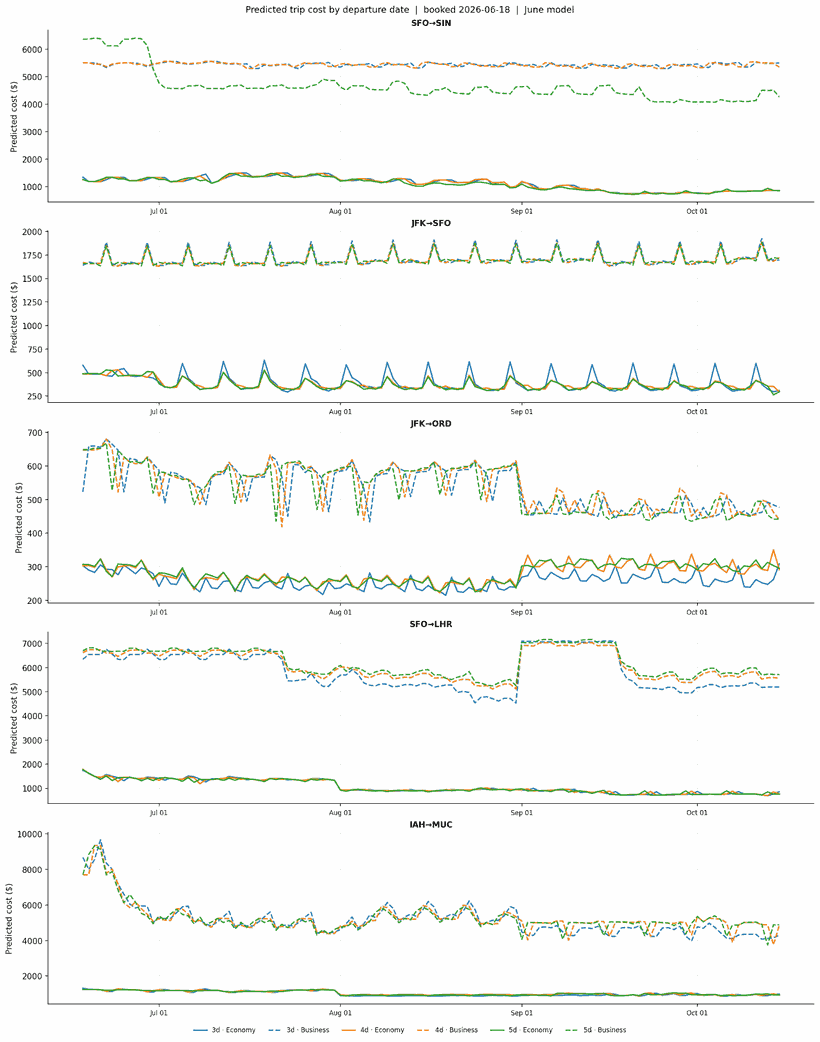
In testing, the model correctly picked up a seasonal fare increase from August into September on a specific transcontinental business-class route it had never seen a single fare for, purely because it had learned that seasonal pattern from other routes and classes. That's the generalization the model is built for: pricing a new city pair or cabin class sensibly on day one rather than needing to see a route before it can estimate it.
Because this model does not explicitly include macroeconomic forces that impact airfares, we need to find a way to estimate those effects. This is done implicitly by periodic retraining (creating a new model) on fresh fare data. This approach guarantees that any force currently pushing airfares up or down is intrinsically absorbed into our predictions, without identifying and quantifying each by name.
This mirrors the same principle behind Clarasight's travel spend forecasting: build a model that learns the current state of the world from recent data, rather than one that tries to explicitly predict every external variable that might move it.
Compared to other model improvement techniques, like adding model complexity through more features or hyperparameter tuning, using more and sufficiently recent data produces the largest accuracy gains, and is relatively cost-efficient and easy to do.
Section 5
Since the model generalizes rather than memorizes, and prediction (once training is complete) is cost-efficient to deliver, we can use it to provide arbitrary market intelligence insights that suit a customer's needs perfectly.
This can be done by feeding the model an entire grid of hypotheticals at once: every candidate city, every plausible departure date over the next several months, multiple trip lengths, multiple cabin classes. What comes back isn't a single fare, but a full forward-looking cost curve for every option under consideration, generated from a single model run.
This demonstrates the real value in the proactive nature of the Clarasight platform: we don't just calculate a single number, but provide the ability to seamlessly compare “New York in August” against “Chicago in September” against “New York in October” side by side, before a single flight has been purchased.
As we retrain the model over time, which is done periodically to incorporate the latest pricing trends and maintain accuracy, we can also keep prior versions around and compare them directly. This gives a rolling view of how forward-looking fares for a given route have shifted, another form of scenario comparison the same construction makes close to free.
An example output from such an analysis is shown below, including predictions for a business-class JFK to ORD route to which the model was fully blinded in training. The effects of lead time, day of week, trim length and fare class all appear in these projections.
Section 6
Predicting airfares will never achieve 100% perfect precision, nor was that the goal of creating this model. The goal was directional accuracy and low bias: individual trip estimates carry error, but that error should roughly cancel out when it's aggregated across all the attendees of a meeting, which is exactly how Clarasight uses it.
By building on a small set of interpretable inputs, correcting for known gaps between quoted and booked fares, and retraining over time, this provides a cost estimate that's a strong solution to plan against today and can be deployed to customers at an efficiency and speed to re-run with high frequency on demand.
The team behind this model has created a purpose-built solution that is powerful while remaining lightweight, flexible and generalizable.
Reference
KEY TERMS
Next Step
To see a demo and explore Clarasight for your program, book time with us.